


You don’t realize it, but most of what you’ve learned and experienced recently has already been forgotten. It’s not personal. It’s the human condition. We can’t do it all.
In recent posts, I’ve focused on those limits because they define the mechanics of our mind. And there is a lot more to know. Before moving ahead, let’s do a quick review.
A Review:
The goal: Every communicator wants to be understood. But too often, explanations fail to connect. Information is ignored or not remembered.
The big questions: Why does that happen? What can we do about it?
The source of answers: Decades of scientific research have led to an understanding of what happens in the mind when an idea is understood and remembered.
Why does this matter? If we understand the mechanisms, we can design communications to work with the mind rather than against it.
We’ve made some initial steps on a bigger path that looks like this:
World → Bubble → Attention → Gauntlet (multiple steps)→ Memory
An Example of Using Cognitive Science
Your job is to get people to remember a ten-digit number after seeing it briefly. You have a choice:
Provide the ten-digit number in a string: 3458560274
Create chunks of digits like a Social Security Number: 34-585-60-274
Because you’re aware of cognitive science, you know that #2 will likely get the best results because the human mind responds best to information in chunks. This is an example of working with the mind that has been understood since the 1950s.
We all have default settings that control how we manage incoming information. The Science of Explanation is being built on multiple insights like the one above.
The World and the Bubble
The path we’re on will help us see every step information takes on the way into the mind. It goes from awareness (you hear someone speak) to memory (you remember what they said). What seems simple is actually a fascinating look at how our minds process information.
The path begins with awareness of the world around us. Because we have human senses, our experience is uniquely human. What we see, hear, taste, smell, and touch appears to be the only experience possible. But it’s not. My dog and the bird outside have different experiences that presumably feel natural to them.
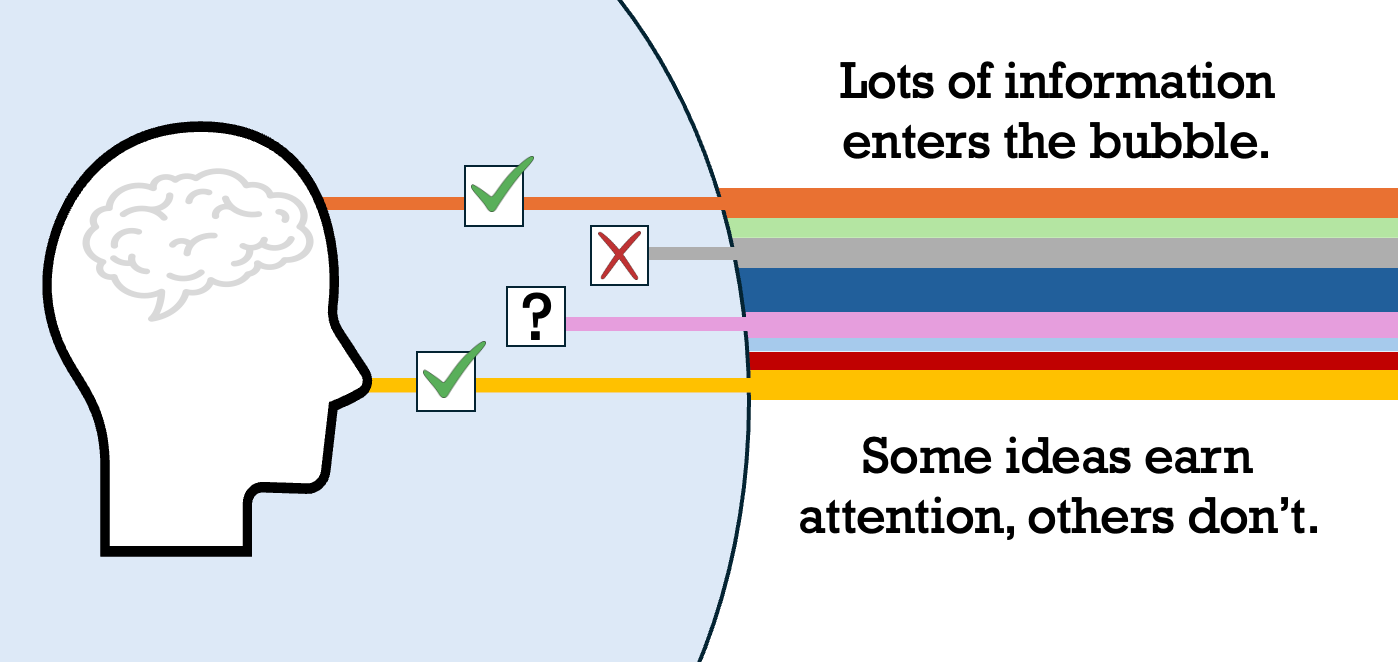
Every animal on earth experiences life inside a bubble that represents the boundary of what can be experienced. Our bubble, the human version, is limited by what our senses can detect. It defines what is available to us, or what becomes a signal at all.
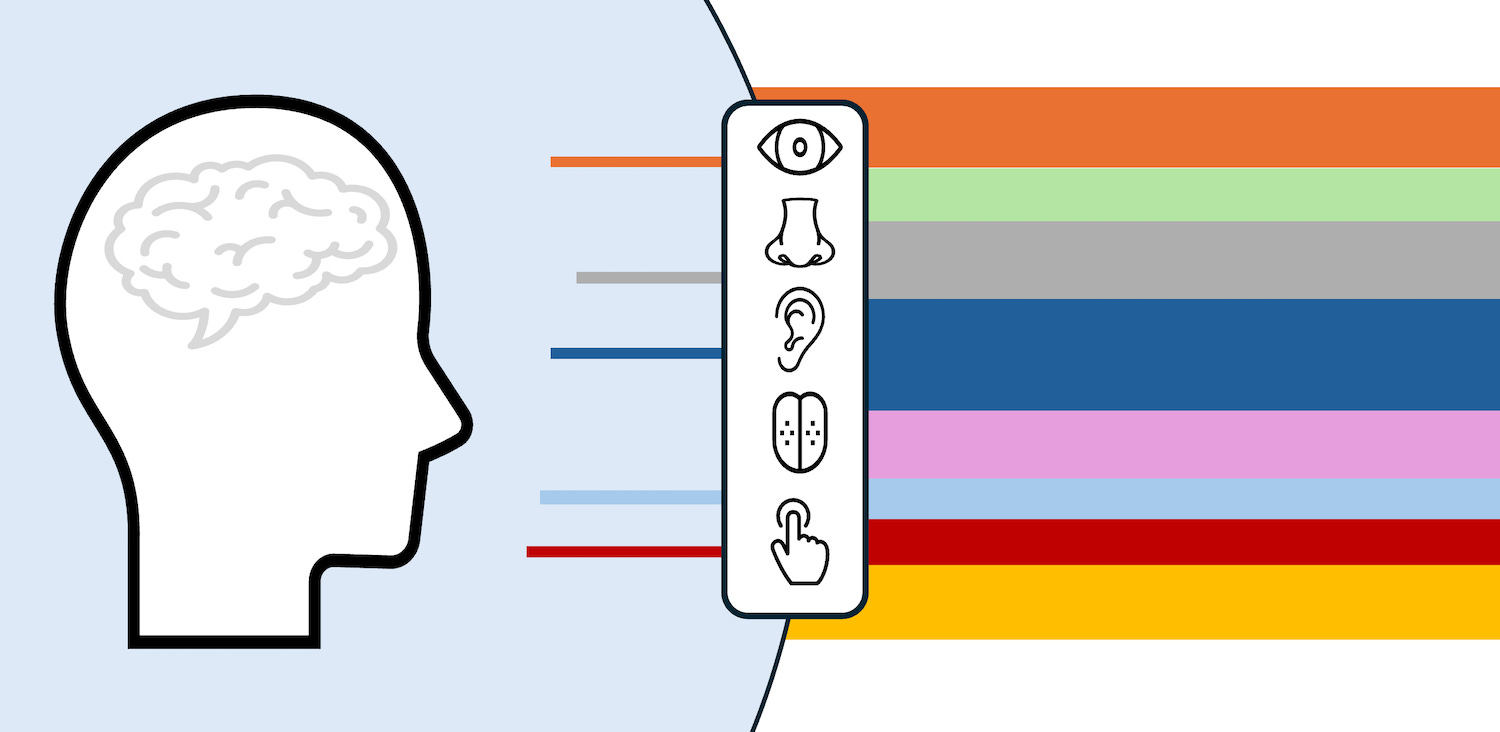
Big idea: Our senses define what signals we can detect from the world around us.
Some Signals Matter More than Others
Imagine reading your favorite book on the couch. You don’t think about it, but you’re surrounded by signals, like music in another room, the hum of the refrigerator, spinning laundry, a dog at your feet. They’re all part of your bubble, but fade into the background. Then two things happen:
The dryer alarm goes off
Your phone buzzes
These enter your bubble at about the same time. You roll your eyes and try to keep reading, but your mind is stuck on the phone and asks: Who is it? What if it’s important? In this competition for your attention, the phone wins and the dryer fades into the background, the loser.
This moment shows something important: signals are constantly arriving in your bubble, but most are not processed. The phone was different; it won your attention, and that set it up for becoming usable information.
Big idea: Attention is competitive. The winner gets processed, the loser fades.
Managing Signals
Attention is essential because it’s like a gatekeeper of the mind. By understanding how it works, we can find ways to earn it and hold it when we communicate.
A key idea is that attention has hard limits. Our minds can’t focus on multiple streams of information at once. For example, we can’t listen fully to two conversations or watch TV while reading a book. You can think of it like a bottleneck that allows only one signal at a time.
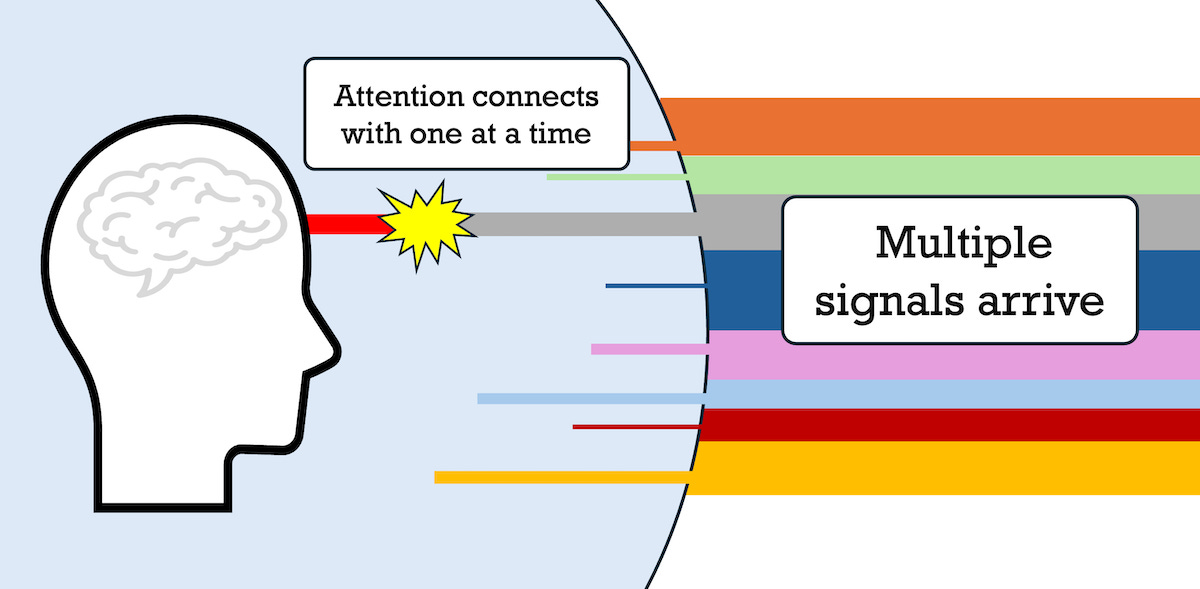
The question becomes: how does the mind select signals? Or more specifically, what signals reliably earn our attention? Research has shown that two factors matter:
Signal strength - We initially pay attention to what is loud and clear around us. Read more
Meaning - We are tuned to focus on what is meaningful, like our safety, goals, relationships, etc. Read more
The buzzing phone earned attention in the previous example because it was loud and was connected to meaning. The dryer alarm? Not so much.
Big idea: Attention is limited and filtered based on signal strength and meaning.
Olivia and the Gauntlet
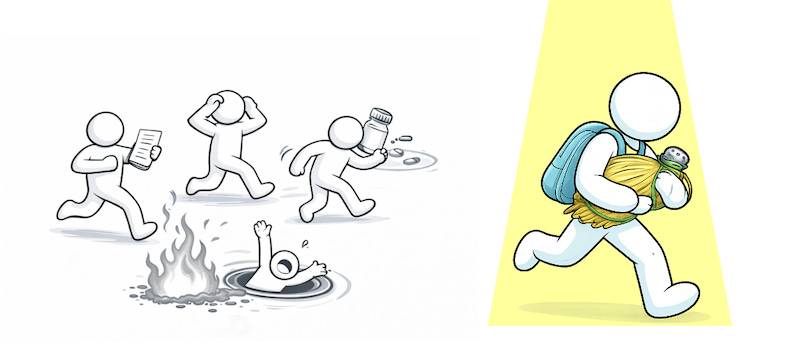
Earning attention is only the first step. Most signals that win attention are still forgotten. Somewhere on the path, they were challenged and lost.
In previous posts, I introduced the story of Olivia, who is distracted and trying to remember her doctor’s advice in the exam room.
In Olivia’s story, we know the outcome: she remembered to eat more fiber, and it became a healthy part of her lifestyle. She forgot all the other advice.
The doctor’s advice to eat more fiber is a survivor. It earned attention and then faced multiple challenges in order to be remembered. It successfully ran the gauntlet of the mind.
The question is: Why? Why did that advice make it through while others didn’t?
The Next Phase
Soon, we’ll step into the gauntlet and look at specific mechanisms that are backed by science and show what an idea faces on the path to memory. We’ll look at context, working memory, mental models, and more.
We’ll follow a path that shows how to design explanations that work with the mind.
Did You Find This Helpful?
Please consider hitting the ♡ button below (it helps others find it)
I’d love to hear from you. Leave a comment
Share it as a recommendation on Substack
Lee, helpful and informative. Thank you.