


Series Summary:
When we learn from an explanation, it feels natural and satisfying. But behind the scenes, your mind is doing a lot of work that you don’t realize. Information is being amplified, filtered, and discarded without conscious effort.
By understanding the mechanics at work and what helps information become memorable, we can craft explanations that are optimized for making the trip.
The upcoming series will focus on the invisible workings of the mind and the default settings we all share. We’ll follow an idea as it tries to survive in the mind, from awareness to being remembered, and what’s required for true understanding.
A Matter of Constraints
As humans, the world around us is overwhelming. Sights and sounds, for example, are too rich with information for our minds to take it all in. So, we are selective. Our minds automatically filter, organize, and discard what we perceive.
When an idea feels meaningful and memorable to us, it’s a survivor. It got attention, competed with other ideas, faced memory limits, was influenced by emotion, and more. Making it through the entire process is rare. Most of what we experience never gets attention or is discarded quickly.
The question becomes: how do we craft explanations that survive?
Real Limits
Let’s do a simple test that illustrates a default setting we all share. It’s based on something well-known in cognitive science.
Read the numbers below and try to remember them:
347846790
Look away from the screen and say them aloud.
Now try again with the same number of digits, but organized differently:
654-196-327
Again, look away from the screen and say them aloud.
For most people, it’s easier to remember the digits that are in “chunks” compared to a long string. This isn’t related to intelligence or effort. Instead, it’s a factor of simply being human. Our minds are tuned this way.
Why Does This Matter?
Consider how numbers appear around you every day, like phone numbers, license plate numbers, and social security numbers. They are all presented in chunks instead of strings.
This isn’t a coincidence but cognitive science at work. A psychologist named George Miller first published this phenomenon in 1956, and helped establish the idea that we have hard limits regarding how many things we can remember at once. This basic idea has stood the test of time. If you want people to remember information, present it in chunks.
I find this fascinating because it’s not about personality, experience, or learning, but a default setting of the mind. We evolved with minds that are tuned for efficiency.
We’ll cover this idea in more detail later.
Working with Mechanisms
The example above is meant to illustrate a big idea: our mind is biased and always at work, whether we know it or not. And today, we have a solid understanding of the invisible mechanisms that make it happen. We can make accurate predictions about what gets our attention, how information is filtered, and what happens when something is remembered, or not.
And here’s the key: if mechanisms are predictable, then explanations can be designed to work with them.
My Goal with the Series
It’s clear to me that the field of cognitive science has a classic explanation problem: the most useful information has limited reach because of how it is communicated. I want to help solve the problem by applying my expertise as an explainer.
In the past, I was more focused on the explainer and taught the practice of repackaging an idea to be more understandable. Now I’m establishing a new perspective that’s focused specifically on the audience and what’s happening in their minds, so that explanations have better chances at survival.
The Gauntlet is a big step toward making cognitive science as real, useful, and engaging as it deserves to be.
What to Expect: The Gauntlet of the Mind
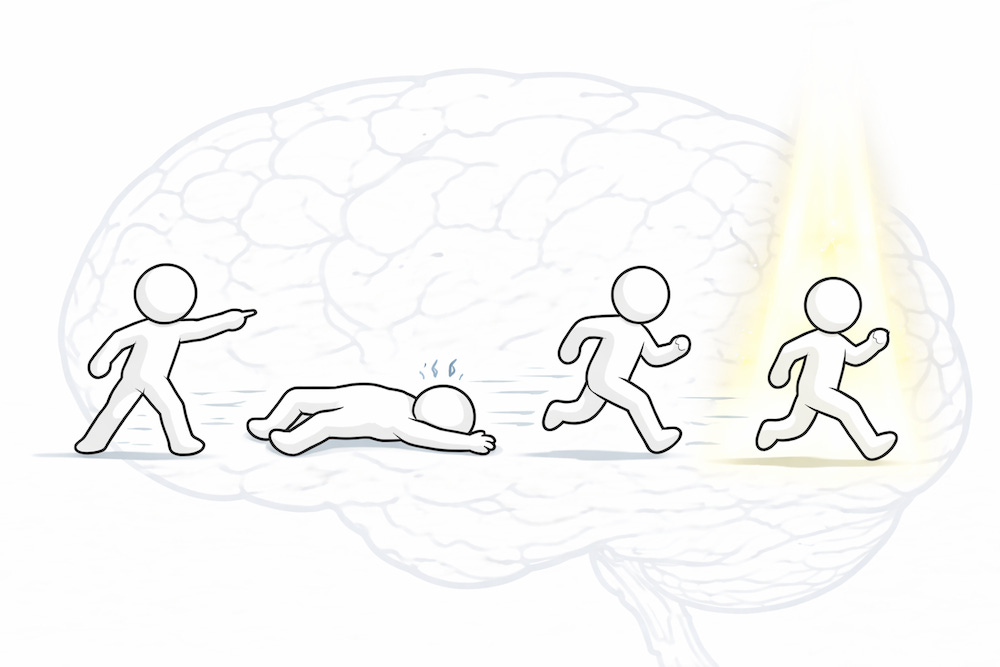
Starting with the next issue, we will follow a specific idea from being communicated to being remembered as knowledge in someone’s mind. I’m calling this path The Gauntlet because the path to knowledge is full of challenges that must be overcome.
Figures like this will be our symbol of an idea that is trying to survive the constraints while facing one challenge after another. Multiple ideas will run the gauntlet, and most will not make it.

We all want to be understood by others. But it’s not easy. By understanding the fundamentals, you can start to see opportunities that were not apparent before, and I’ll be your guide through every step.
Know someone who would love this series? Send them to ScienceofExplanation.com
If You Enjoyed This Post
Please consider hitting the ♡ button below (it helps others find it)
I’d love to hear from you. Consider leaving a comment.
I’m intrigued.
Particularly when you recite
A long telephone number
Only to find the receiver
Has a poor memory,
Or no pen and paper.
:
Explanations need a receiver
A listener, if you like.
They also need testing
(How many times have you
Read instructions without them
Having been tested).
:
Are we here to uncover
The Art of Explanation?
Or simply to find out
How the brain works and
How we understand things?
:
Lorne
This is needed. Thanks, looking forward to the series.