


I was never a good math student. I could pass tests, but I never developed a big-picture understanding of algebra or trigonometry. I could have studied harder, but throughout my life I assumed it was how I was being taught.
Today I think of my experience in terms of cognitive load and the pressure math put on my working memory. Below, we’ll see why.
A Quick Refresher
We recently discussed how the human mind can work with about four “chunks” of information at a time. Four numbers, four concepts, four names. Once our working memory is occupied, it can’t manage more information without making mistakes.
Cognitive load is the total pressure placed on working memory. The big idea: if we can understand the sources of the pressure, we can manage cognitive load.
In the most recent post, I explained two types of cognitive load:
Intrinsic load: Some things are naturally complicated. Quantum physics has a high cognitive load for the layman; basic addition has a low cognitive load for most people.
Extraneous load: Presentation matters. When a diagram is poorly designed, or sentences have too much jargon, cognitive load increases.
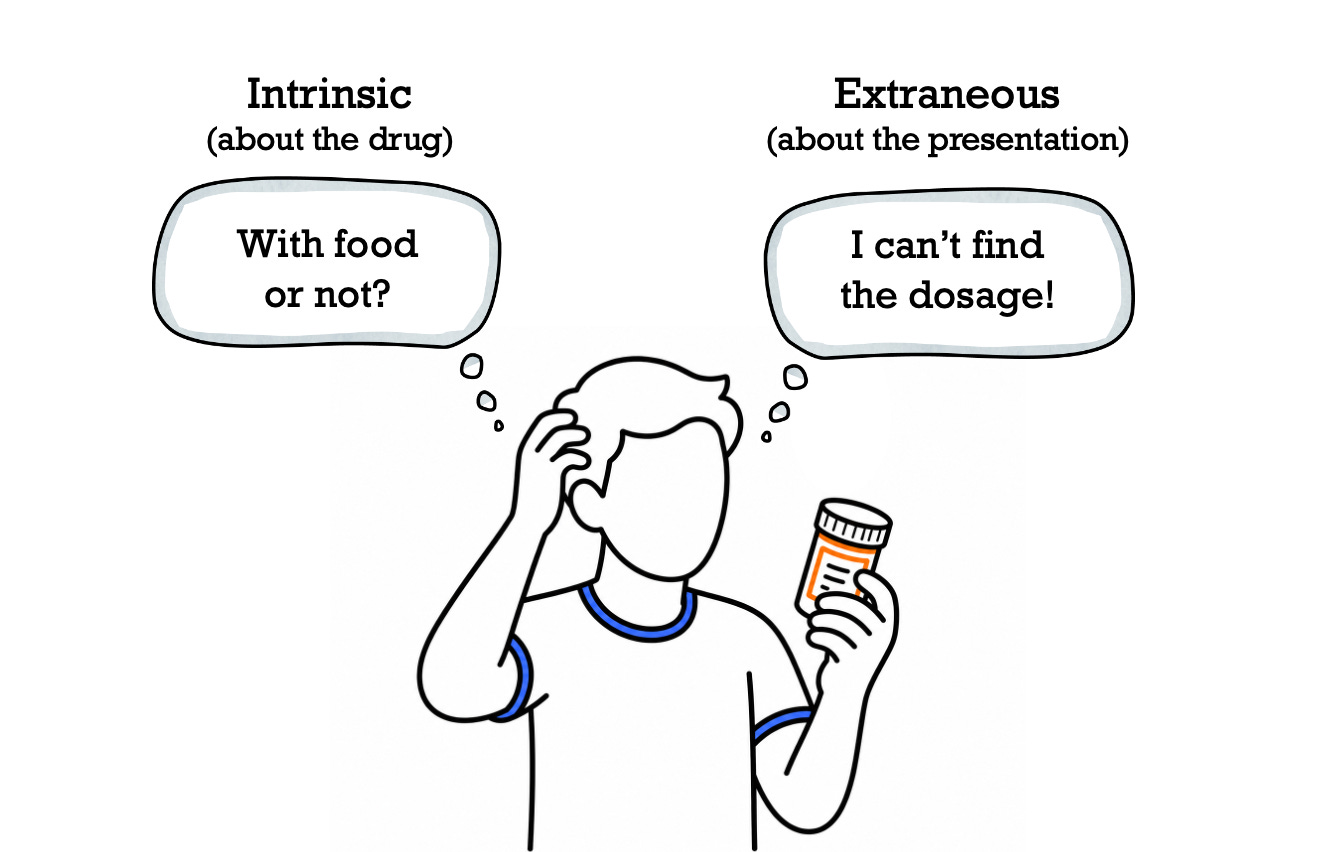
Below, we’ll look at a specific study, replicated multiple times, that shows cognitive load in action, and why it’s useful for communicators.
Meet John Sweller
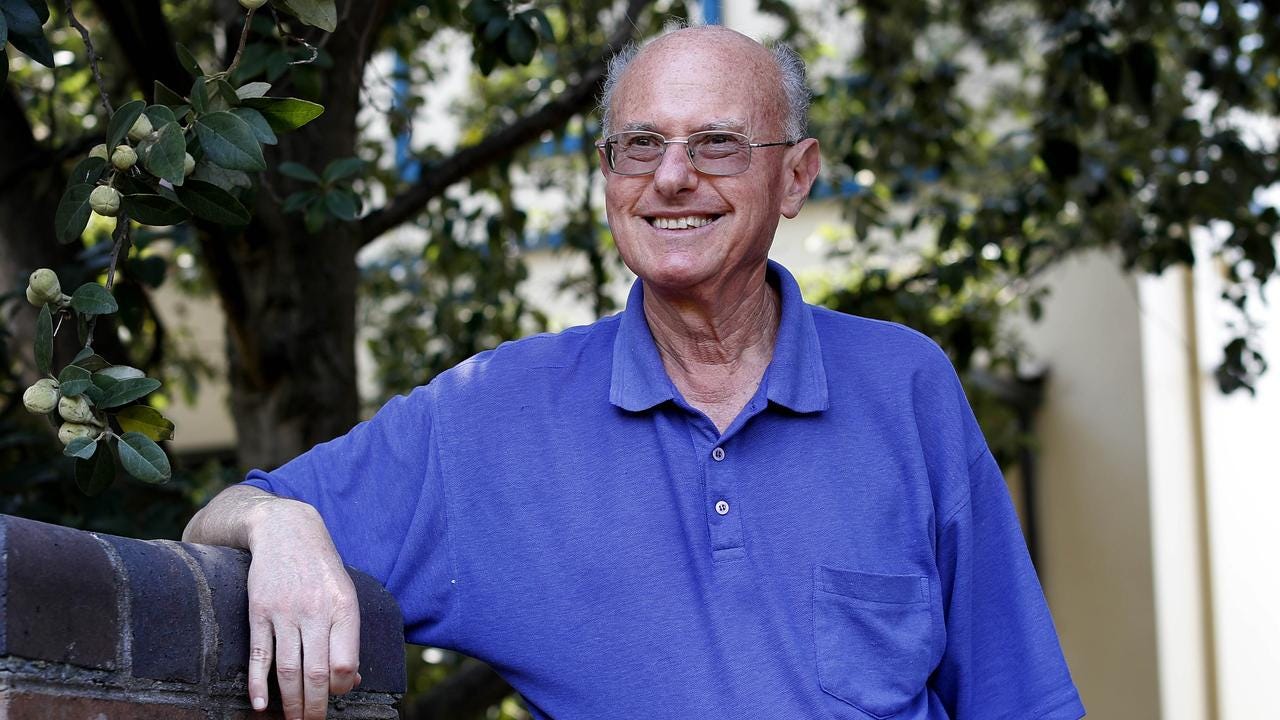
In the late 1980s, John Sweller, an educational psychologist, was studying problem solving in mathematics.
He noticed something fascinating: a specific math problem could be presented in multiple ways, and student success seemed connected to presentation style. The complexity of the problem itself didn’t matter as much as how it was being presented.
At the time, the mainstream view of learning math was based on practice. Learners are presented with a problem and learn by attempting to solve it. This trial-and-error process, it was thought, was how math was learned.
One of Sweller’s most famous studies challenged this idea and discovered something fundamental about the mind.
The Experiments
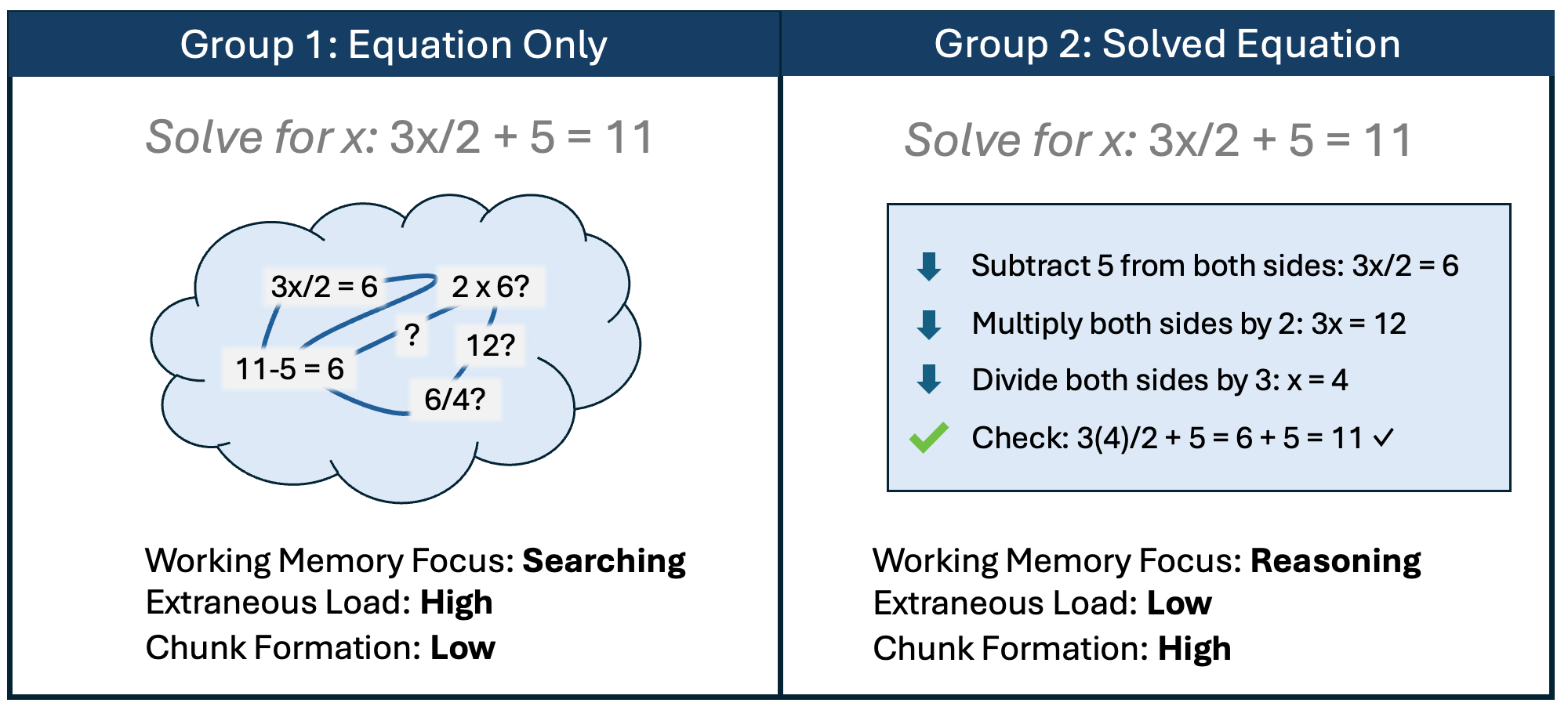
Sweller gathered two groups of novice math students who were tasked with solving a specific algebra problem.
Group 1 was provided the problem with no solution. They had to work through trial-and-error to get the answer.
Solve for x:
3x/2 + 5 = 11
Group 2 was provided a solved equation. They could see how the pieces fit together, what led to the solution, and why.
Start: 3x/2 + 5 = 11
Subtract 5 from both sides: 3x/2 = 6
Multiply both sides by 2: 3x = 12
Divide both sides by 3: x = 4
Check: 3(4)/2 + 5 = 6 + 5 = 11 ✓
The big question: What group performed better in the future?
Sweller’s work and subsequent experiments showed something new: The students who learned via the solved equation (or “worked example”) performed better on similar problems than those who had to find the solution.
This challenged decades of learning theory. The question was why.
Working Memory and Math
Sweller proposed a new idea that led to Cognitive Load Theory (CLT) and explained the difference between the two groups using working memory.
Group 1 was provided a problem to solve, and they searched for a solution. The trial-and-error approach put a lot of pressure on working memory, which was used for experimenting rather than creating chunks of knowledge.
The student’s cognitive resources were used for solving the puzzle of the equation rather than understanding the process.
Group 2 was provided the solved equation. Here, the process was laid out in steps, with no trial-and-error required. Instead of using working memory to solve a puzzle, they could use it for understanding the logic, which led to chunks forming more easily.
And in the long run, the formation of those chunks is what helped the students who saw the solved equation do better on similar problems.
A Surprising Measurement of Cognitive Load
Cognitive load seems like a theory that exists mostly in models and diagrams. But in reality, there is a physical response that makes it measurable and therefore more scientific.
The big idea: when cognitive load goes up, our nervous systems respond in a way that makes our pupils dilate. This is called the task-evoked pupillary response.
Researchers Kahneman and Beatty designed studies that asked subjects to remember strings of numbers and then recall them. During this process, they measured their pupil dilation.
The results were fascinating. The subjects' pupils grew as numbers were added and shrunk as the subjects recalled them. It’s not hard to imagine working memory being filled up and then relieved.
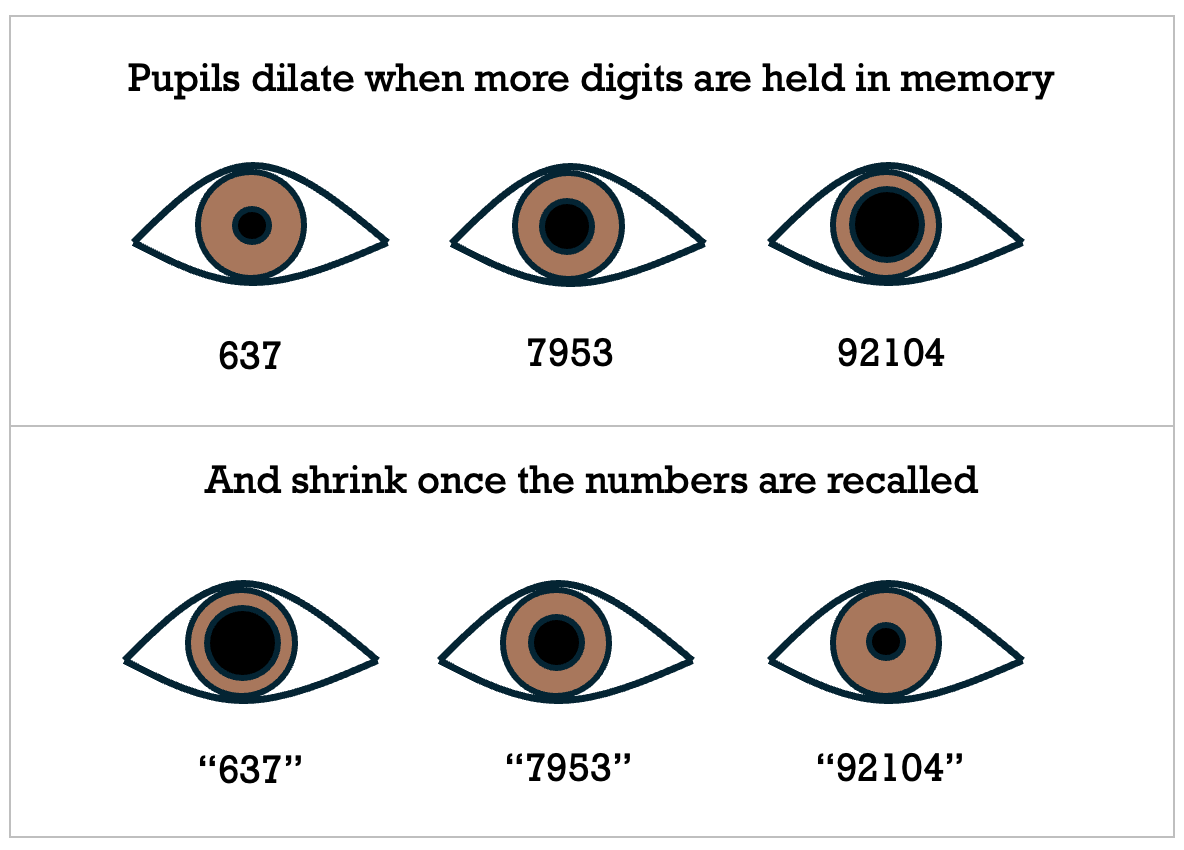
So what? This discovery gave cognitive load theory a more concrete foundation. As we’ve seen before, when an invisible mechanism in the mind can be linked to a physical reaction, the idea becomes more valid.
This review of the research by Pauline Van der Wel and Henk van Steenbergen is helpful in understanding the specifics.
Why This Matters: Show Your Work
When we communicate, we ask the audience to understand what we say. Cognitive Load Theory tells us that a new idea may look like a puzzle to the audience. Their mental resources are used for fitting pieces together instead of remembering the big ideas.
Instead, we should consider showing them the finished puzzle and then the steps it took to assemble it. This helps remove the extraneous load and allows their working memory to be used for something more productive: developing new chunks that can be employed in the future.
If You Enjoyed This Post
Please consider hitting the ♡ button below (it helps others find this post)
I’d love to hear from you. Leave a comment, and we can chat.
Know someone who would enjoy this? This post is public, so feel free to share.
So, here's what's running through my mind. Do I want to develop more "reasonable sized" chucks to understand a complex topic or do i want to develop fewer "mega-chunks?" Mega-chunks may may it easier for me to understand something but harder to explain it to others. More reasonable-chunks may make it easier to explain my understanding but might it overload my memory? Can you dig into the granularity of chunks? Or is that not an issue?