


Friends, I hope these posts help you understand not just what we know, but how we came to know it. The everyday work of researchers isn't often glamorous or exciting, but over time it produces new insights and greater confidence in what we can know about the mind.
A Quick Test
Imagine that you’re driving a car in the middle of nowhere and low on gas, maps, and cell signals. You’re lost and stop at a farmhouse where a kind gentleman gladly gives you instructions.
You listen carefully and assume you can remember everything.
“It’s easy. Turn left out of my driveway and at the next stop, turn right and then go until you see a big red barn. After the barn, there is a road on the left called ‘Smith Rd.’ Turn left on Smith and go for about 3 miles, and you’ll see the gas station on the right.”

By the time you get to the barn, your gas is getting lower, and you start to question your memory.
What was the name of the road after the barn?
Do I turn left or right?
How many miles to the gas station?
This is working memory in action.
You didn’t fail. This isn’t about intelligence, but capacity. You encountered one of the built-in limits of the human mind. We cannot remember everything at once.
The question becomes: how many things can we remember? If we knew that data point, we could use it in designing communication. This is the story of researchers who searched for, and found, that number.
The Science Behind Working Memory
George Miller was a cognitive psychologist at Harvard in the 1950s. Over years of research, he noticed a pattern in the data regarding human memory. Across experiments and papers, the number seven kept appearing.
In the introduction to his most famous scientific paper, he wrote:
The persistence with which this number plagues me is far more than a random accident. There is, to quote a famous senator, a design behind it, some pattern governing its appearances. Either there really is something unusual about the number or else I am suffering from delusions of persecution.
Miller ran his own experiments and also synthesized existing research from other labs. Across very different experiments that asked subjects to remember sequences or count objects at a glance, the same number kept appearing: seven.
His 1956 paper “The Magical Number Seven, Plus or Minus Two” is one of the most cited papers in psychology because it popularized the idea that humans remember information in “chunks” and provides evidence that the mind can reliably remember a specific number of chunks: seven, plus or minus two.
The Problem with the Magic Number Seven
Miller was honest about the limitations of his findings and the rough-estimate nature of the number seven.
The problem: Miller wasn’t focused on working memory as we know it today. His experiments were not designed to isolate working memory.
For example, his subjects were allowed to use memory hacks, like mentally repeating the numbers, to increase their scores. This mental repetition is called “rehearsal”, and it makes it difficult to measure working memory by itself.
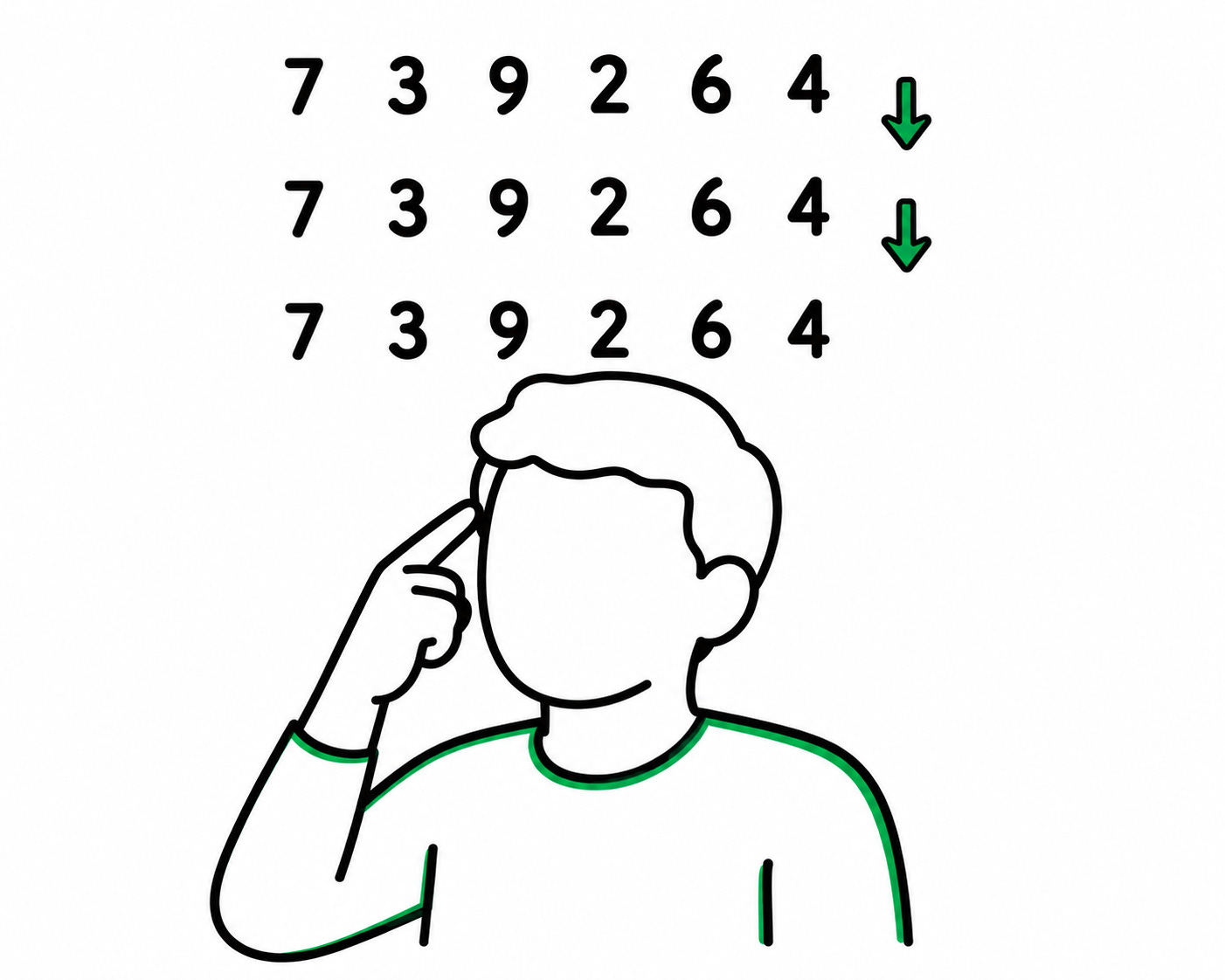
Miller was right about the power of chunking, but his numbers needed another look.
Seven or Four?
Psychologist Nelson Cowan at the University of Missouri studies working memory. Starting in the 1990s, Cowan’s lab published multiple papers about how to isolate and measure working memory.
In 2001, he reviewed existing studies that had controlled for rehearsal, combined them with his own laboratory research, and published a response to Miller's famous paper. It was called:
The magical number 4 in short-term memory: A reconsideration of mental storage capacity
Cowan wasn't just controlling for rehearsal. He identified three strategies that inflate working memory performance beyond its raw limit: rehearsal, long-term memory chunking, and sensory memory assistance.
The research pointed to something remarkable: when working memory is isolated, it can be measured with more fidelity. Across multiple sources, he found that the human mind can remember about four chunks of information at a time. Anything over four causes predictable problems.
You may wonder: how does one measure such a thing?
How to Measure Working Memory
At any moment, our minds are doing multiple things. I’m typing and reading these words, but I’m also listening to music, smelling coffee, etc. It feels normal.
What is not normal is the opposite: isolation. Preventing the mind from doing something natural and specific is much more difficult. But that’s precisely what researchers do to measure working memory.
Remember the subjects above who were “rehearsing” by mentally repeating the numbers in order to remember them? This is something we do naturally and mostly unconsciously. We have an “inner voice” that’s always helping.
The problem is that the inner voice is always on when we’re trying to remember something. The question becomes: how do you prevent people from rehearsing what they are trying to remember?
The answer: by distracting it. An example experiment where researchers are measuring working memory:
Subjects hear a set of numbers to remember
Then they are instructed to immediately count backward, aloud, for a period of time. This prevents them from rehearsing.
Then, they are asked to recall the numbers they heard.
In this experiment, it’s possible to get a clearer picture of working memory because backward counting occupies the same brain function as rehearsing, without helping memory.
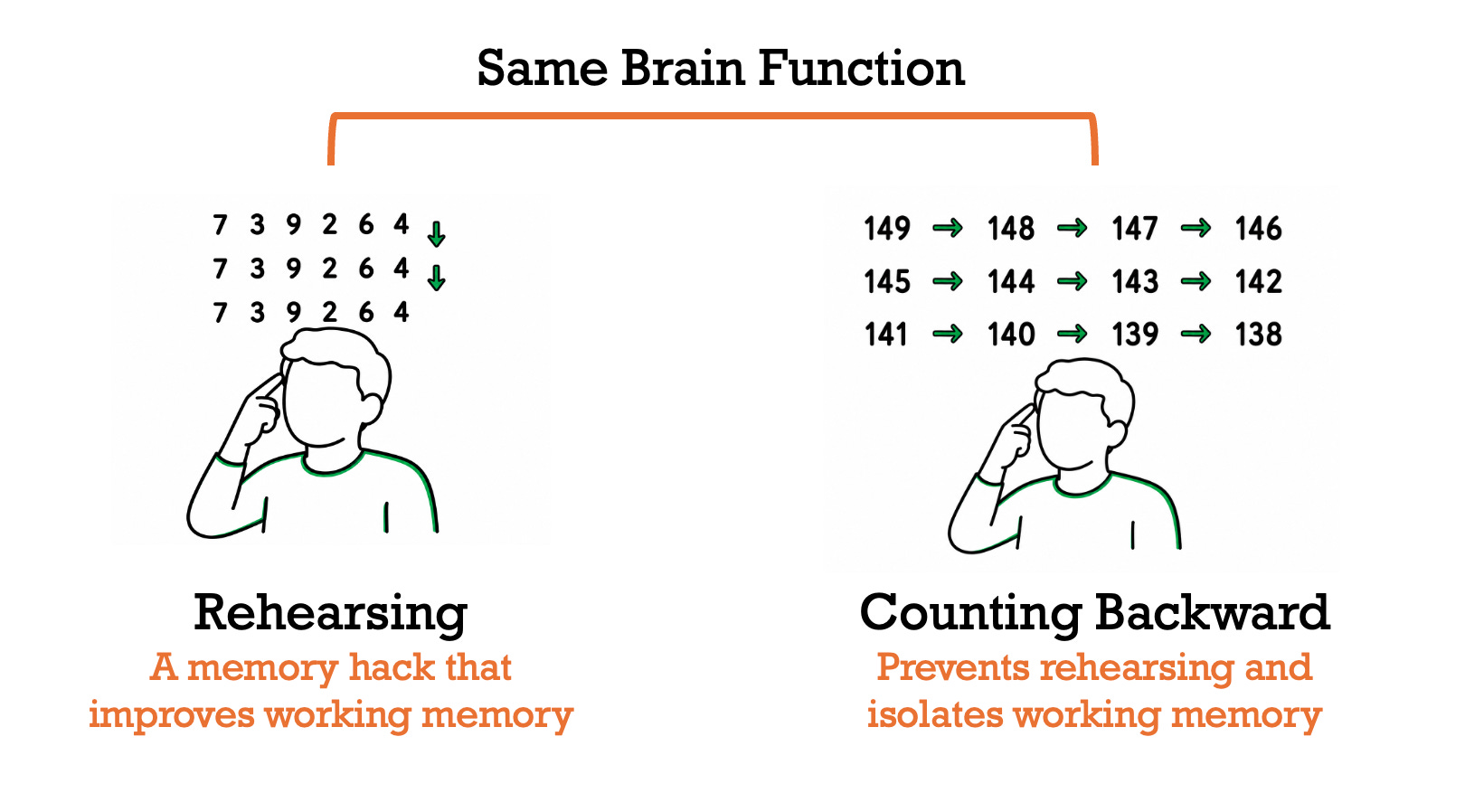
This methodology is used in a variety of research. Cowan reviewed these studies along with his own research and proposed that the more accurate number of chunks we can remember is four.
His influential paper kick-started a new direction in working memory research that continues today.
Olivia at the Doctor
This is why Olivia remembered the fiber advice and forgot the treadmill. Her working memory was limited, and the doctor’s recommendations had to compete.
She was distracted and hearing a lot of information at once:

She didn’t realize it, but some of that information had a distinct advantage. Because she already had knowledge about cholesterol and heart health, the doctor's new advice about fiber attached itself to an existing mental structure.
Rather than becoming another separate item competing for space, it became part of a larger chunk.

The treadmill didn’t have the same foundation or meaning. It became a separate item in her mind competing for limited space.
What this Means for Explanation
First, the obvious: your audience can easily be overwhelmed. Don’t squander the attention you’ve earned with long lists or multiple sub-points. The magic number four can serve as a guide for how much to say at once.
Second, think about your points in terms of chunks of related ideas. Whenever possible, connect new ideas to concepts your audience already understands. Existing knowledge creates larger chunks, making new information easier to hold in working memory.
Third, working memory is like a competition. Some information makes it through, and some doesn’t. What will help your idea survive?
As we’ll see in the next issue, the idea of chunks is more fascinating than it appears. It’s a metaphor that provides a vivid way to think about how we learn and understand the world around us.
If You Enjoyed This Post
Please consider hitting the ♡ button below (it helps others find this post)
I’d love to hear from you. Leave a comment, and we can chat.
Know someone who would enjoy this? This post is public, so feel free to share.