


Last week, I used an example of a bicycle to illustrate four types of understanding. Together, they help us see the reach and limits of how we understand an idea, person, object, process, etc. The questions are:
What is it?
Why does it work as it does?
Where else does this work?
What does it help me do?
Neuroscientist Tommy Blanchard described it this way:
One way of testing for understanding is to test if the person would know what would have happened if something was different. Being able to answer counterfactual questions shows the person has something that goes beyond surface level memorization, since it requires reasoning based on a deeper structure of the phenomenon.
Clear enough. Rote memorization rarely represents understanding. What’s more important is seeing the big picture of how things fit together.
The Problem
Understanding is often hard work. It uses up attention, working memory, and other mental resources. We don’t always invest the effort needed to examine how something works. We easily jump to conclusions that make us feel that we understand.
Put simply: we fool ourselves into thinking we understand more than we do.
This isn’t a character flaw or lack of intelligence but a natural way the mind processes information. Our minds seek resolution or fit, and often, we convince ourselves that a subject is resolved without a full understanding.
“Of course I know how X works; I do X every day!”
This is a problem for communicators because once someone feels that a gap has been filled, they may see little reason to keep looking. “I understand that now” is a convenient way to head off any further exploration. And often, it’s wrong.
How Do We Know?
In 2006, researcher Rebecca Lawson conducted a series of experiments that illustrated the difference between what we think we understand versus what we actually understand.
She asked research subjects (experts and non-experts) to rate their knowledge of how bicycles work on a scale from 1-7, with 7 being thorough knowledge. The initial averages showed their confidence:
4.6 and 4.2 for non-experts
5.4 for experts
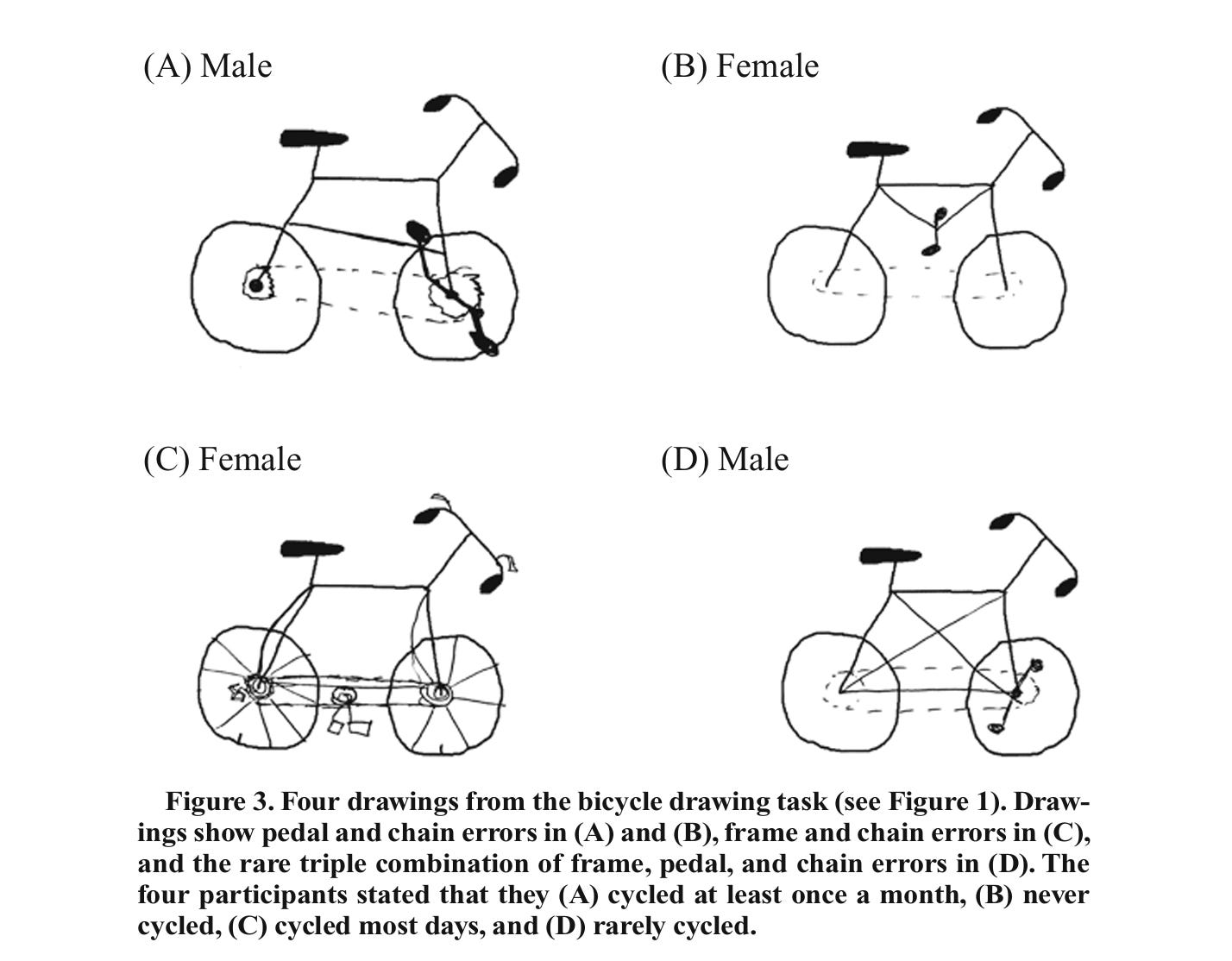
Lawson then asked subjects to draw the missing pedals, chain, and frame along with the chain’s connection to the rest of the bike. The image below is from her 2006 paper: The science of cycology: Failures to understand how everyday objects work:
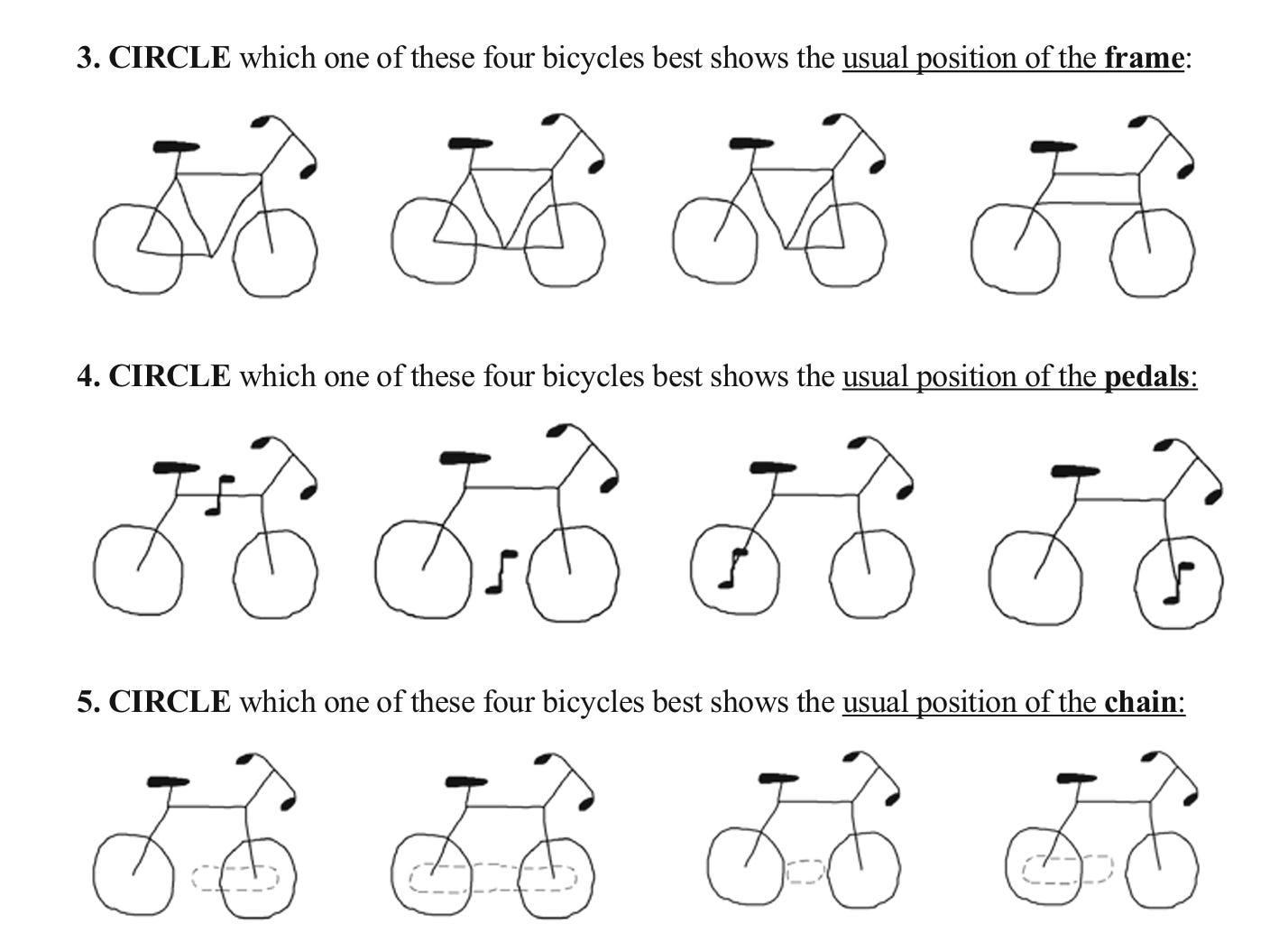
She also asked multiple-choice questions about the correct positions of various bike parts. This image is also from her paper:
The results were surprising.
44% and 60% of the two non-expert groups made at least one drawing error, compared with 9% of experts.
From the paper:
What is striking about the present results is that so many people have virtually no knowledge of how bicycles function. They do not appear to understand a simple set of causal relations (turning the pedals turns the chain that spins the back wheel that drives the bicycle forward); therefore, they do not know how turning the pedals moves a bicycle.
Another Study
At Yale, Leonid Rozenblit and Frank Keil conducted a similar experiment in 2002, which they shared in the paper The Misunderstood Limits of Folk Science: An Illusion of Explanatory Depth.
In this study, the researchers asked 16 undergraduates to rate their understanding of devices in simple terms. The devices included a speedometer, flushing toilet, quartz watch, and more. The students then had to write a detailed explanation of how the devices work. After generating their explanations, they could then re-rate their understanding.
Consistently, the students lowered their level of understanding of the device after attempting to explain it. This led the researchers to conclude that having to explain concepts and mechanisms forces people to reckon with what they understand, or not.
Rozenblit and Keil coined a new term for this phenomenon: The Illusion of Explanatory Depth
The Illusion of Explanatory Depth
The studies above provide an example of human nature. We easily confuse familiarity with understanding.
In the case of the bicycle, there is little need to understand the mechanics at work. We pedal; the bike goes forward, and it seems like that’s all there is to know. It feels like understanding.
Consider something common like a zipper. We all use them successfully and assume we know how they work. But do we?
You’d expect someone with a moderate understanding of a bicycle to know the mechanics and how the parts relate. But many participants made mistakes. Their familiarity created an illusion of understanding.
The experiments showed that there were real gaps in understanding how bicycles and other items are structured and the mechanics that make them work. Those gaps only appeared when subjects were asked to explain them.
Ask yourself: what familiar parts of daily life do I assume I understand?
Why Does This Matter?
Our minds are tuned to solve mysteries and feel the rush of understanding. In this quest, we easily convince ourselves that we understand more than we do. Relying on familiar patterns and assumptions saves us from analyzing every situation from scratch.
First, check your understanding. If you need to explain something, don’t depend on assumptions. Write down what you know about the mechanisms and relationships between ideas and check them against the facts.
As a communicator, part of your job is to ensure that your understanding is accurate and that the audience shares a similar understanding of the subject. Everyone needs to be on the same page.
How?
Don’t assume everyone understands. The people confidently nodding their heads may feel as if they understand, but it could easily be an illusion. Build context. Make the connections visible. Show the causal chain.
By taking the time to discuss the relationships between ideas and the mechanisms at work, you can create a stronger foundation for related ideas. This gives them an opportunity to adapt their existing knowledge and be open to new information.
Next Up
Soon we’ll look at how the mind organizes what we know into patterns that help us see connections and make predictions, and why those same patterns can sometimes lead us astray.
If You Enjoyed This Post
Please consider hitting the ♡ button below (it helps others find this post)
I’d love to hear from you. Leave a comment, and we can chat.
Know someone who would enjoy this? This post is public, so feel free to share.