

Friends, I didn’t expect to get pulled down a rabbit hole by trying to understand logic and reason, but here we are. Honestly, I could write ten more posts, but we must move on. I’m wrapping up the recent posts with a practical look at how to evaluate claims: ones you make and ones made by others.
The Thermostat
A few weeks ago, we looked at an example using a dial on a thermostat to show how misunderstanding creeps into our thinking.
When using a stove, we can see that turning the dial increases gas flow. More turning = more gas = faster heating.

Having had this experience, it becomes a pattern in our minds, where we can apply it to similar situations, like a home thermostat.
We think: turning the dial all the way up on my home thermostat will heat faster.

It seems logical and is a common misconception. We’re revisiting this example to show what needs to be in place for us to believe a claim, and why we so easily get it wrong.
Settling an Argument
Imagine a couple having an argument about the thermostat. Person 1 is making a claim: “Turning the thermostat dial will heat the room faster.” Person 2 disagrees and says, “I think you’re wrong,” and adds a pointed question, “Why do you think that?”
This is a question about the premise of the argument. A premise is a statement that we accept as true and use to reach a conclusion. We often reason from premises: things we believe. When we’re wrong, it is sometimes a faulty premise that gets in the way.
In our example, Person 1 is working from this premise: Turning a heat dial higher makes things heat faster. To them, it seems like a fact, so the rest of the reasoning works.
Turning a heat dial higher makes things heat faster. (Premise)
I turned the thermostat higher. (Premise)
So the house will heat faster. (Conclusion)
The source of the problem originates in the premise. Person 1 has a belief that feels true, in part, because it’s logical. They continue to push.
Person 2 feels frustrated and says, “That’s not how our thermostat works.” They create an alternate argument:
The heating system runs at a consistent output until it reaches the target temperature. (Premise)
I turned the thermostat higher. (Premise)
Therefore, the heater will keep running toward the target temperature without increasing its output. (Conclusion)
Now we have two versions to consider, both of which seem logical to each person. We can work out who to believe by considering the premises.
Which Premise Is Correct?
Evaluating premises means thinking about sources. Where does your knowledge come from? According to whom? What’s the basis?
In our example, we have two different claims that rest on two different premises. Again, we return to the pivotal question: why do you believe that?
Let’s take a closer look:
Person 1: Turning a heat dial higher makes things heat faster.
Person 2: Why do you believe that?
Person 1: It’s like a dial on a stove
Person 2: A thermostat sets the target temperature, not the heating speed.
Person 1: Why do you believe that?
Person 2: Because I read the heating system manual, and it says so.
Above, we see the power of sources. Which source gives us a better reason to believe the claim?
Person 1 is drawing on experiences using a stove. That experience is real, but doesn’t establish how a home heating system works.
Person 2 is drawing on the manual for the heating system, written by the people who built the machine.
It’s easy to see what claims should be believed. The instruction manual gives us better reasons for trusting Person 2’s premise because it describes the system they’re discussing. It doesn’t make the premise true; it provides evidence that it is true.
Personal experience can be powerful, but here it led Person 1 to a familiar pattern that doesn’t fit. This happens all the time. We are easily led astray by arguments that feel true and reflect our experience, but are based on assumptions or beliefs that are shaky.
A Structure for Finding Truth
The structure we’ve been using has a name: a syllogism (which translates roughly to “reasoning together”). A syllogism is a simple argument with three parts: two statements we accept as true, along with the conclusion they lead to. This is also a form of deductive reasoning.
Syllogisms always work with the same rule: If the premises are true and the logic holds, the conclusion must also be true.
The most famous syllogism is this:
✅ Socrates is a man (known truth)
✅ All men are mortal (known truth)
✅ Therefore, Socrates is mortal (truth)
The premises are correct, and the logic holds. This structure guarantees that the conclusion is true.
The Structure
Arguments have structure, and by understanding that structure, we can inspect where an argument goes wrong. In philosophy, this is logic and epistemology at work. Why do we believe what we believe?
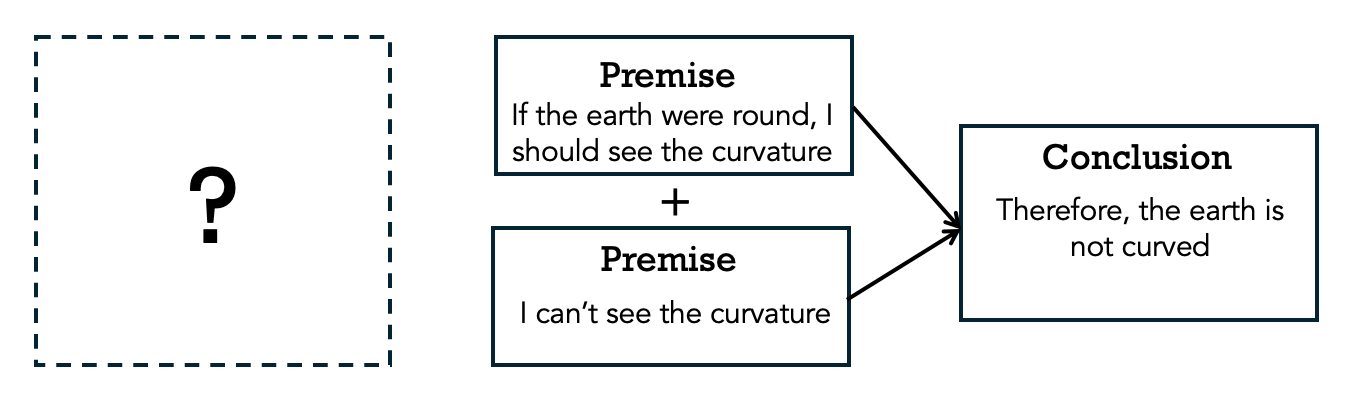
Here’s the basic structure:

Let’s consider an example of someone who believes the Earth is flat:
If Earth were curved, I would be able to see that curvature from where I’m standing. (Premise)
I can’t see the curvature (Premise)
Therefore, Earth is not curved. (Conclusion)
To someone who accepts the premises as true, the conclusion can seem very convincing. The logic holds.

But a question lingers: What supports the premises? What is the basis or evidence for this belief?
The problem lies in the first premise. It contains an assumption that the curvature should be visible to the believer.
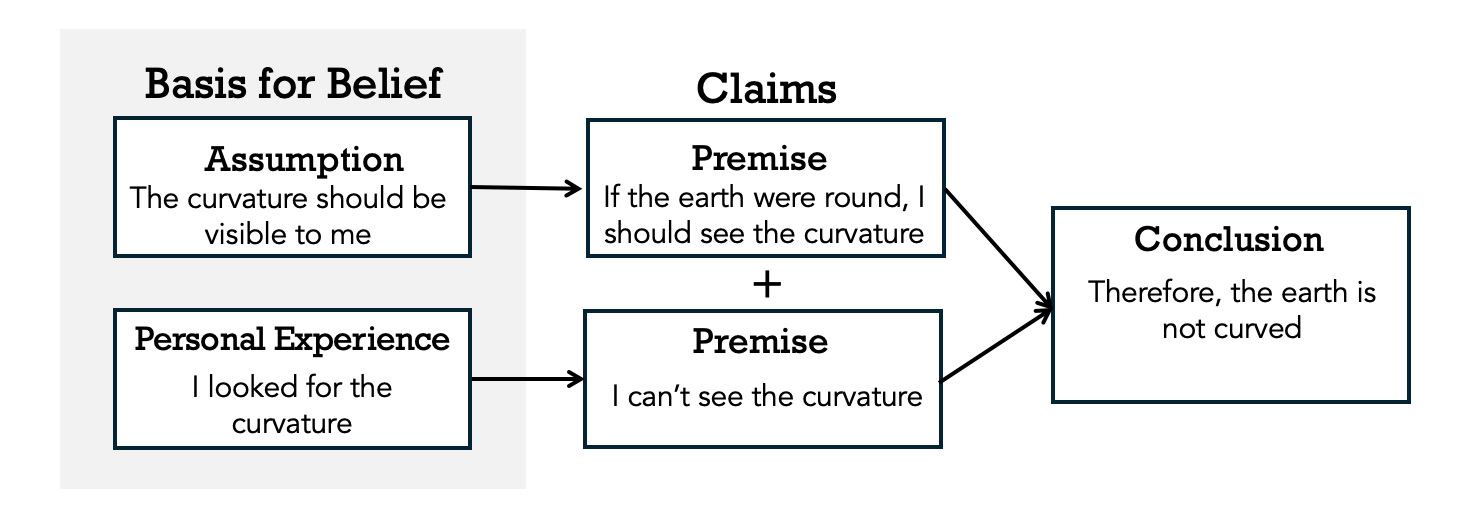
Here, we can see that the basis for belief is an unsupported assumption. The Earth is so large that a small part of it can appear flat. We should not accept this belief because one person can’t see the curvature. The second premise is acceptable because we can accept that the person doesn’t see the curvature.
Now we can see the structure and how to evaluate what to believe:
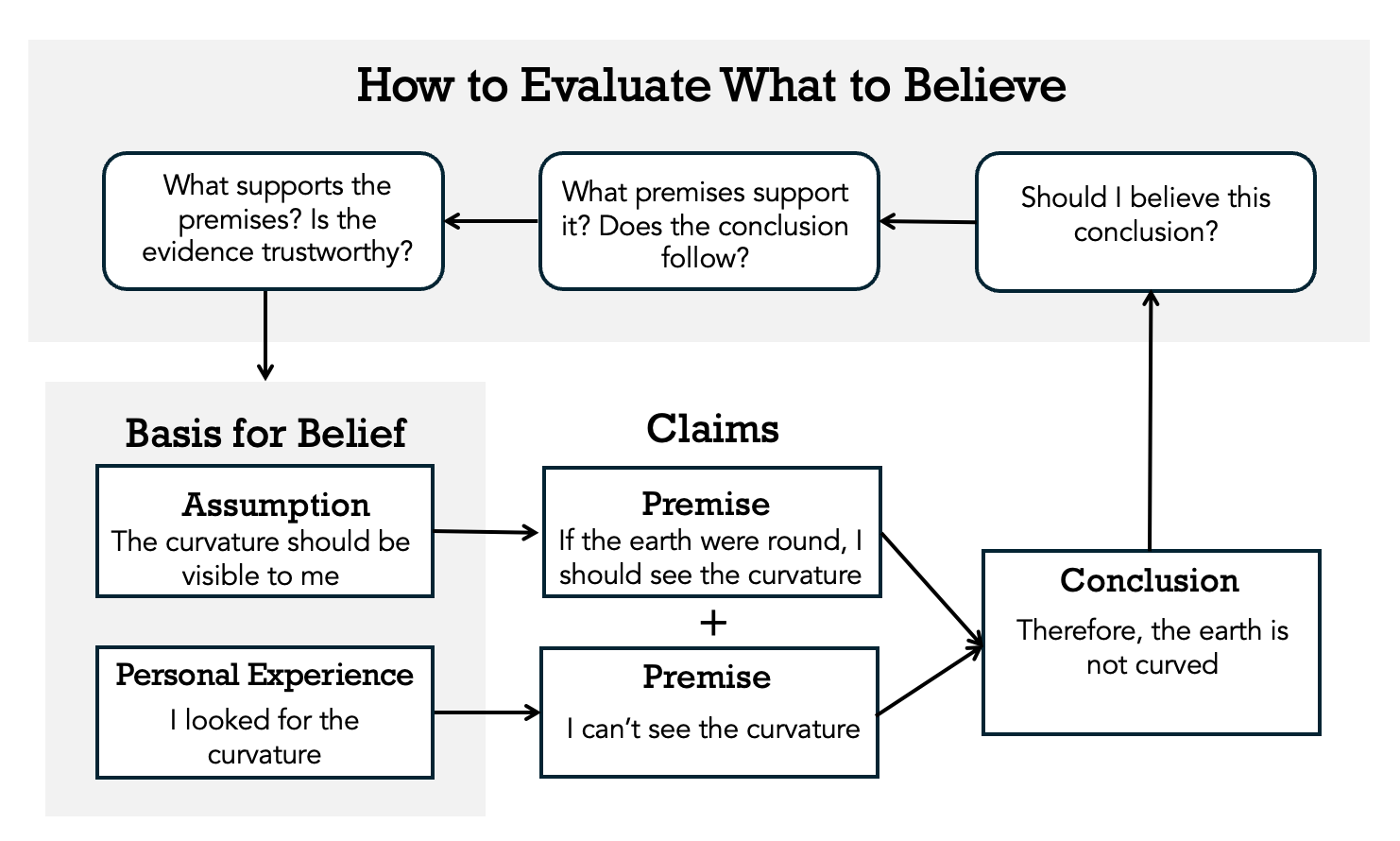
Of course, this analysis is not a proven way to change minds. People are stubborn in that way. What it can do is provide you with a tool for working out what should be believed and how to think about trustworthy arguments.
A Challenge
The next time you hear someone making a claim, take the time to think it through. Consider the premises they are working from and what supports those premises. You can ask, “According to whom?” and then look for their sources and what is trustworthy.
The same is true for your own beliefs. The next time you want to argue a point, take a step back and consider the premises you’re working from and the basis of those beliefs. If your premises are true, does the conclusion logically follow? Why do you believe what you believe?
If You Enjoyed This Post
Please consider hitting the ♥️ button below (it helps others find this post)
I’d love to hear from you. Leave a comment, and we can chat.
Know someone who would enjoy this? This post is public, so feel free to share.
Ah, if only all marital disputes could be resolved via an owners manual. Then we could just say, RTFM, or I am sure I am right, and the manual is probably still in the trash can.