


In the last post, I introduced the idea that we don’t share knowledge directly, but create and share representations of knowledge in words, diagrams, data, and more. Now we’re turning to where these representations live: the real world.
To explain successfully, there has to be a sense of shared reality that creates the baseline for evidence and truth. We explain what we believe is real. Unfortunately, this sense of reality is not evenly shared. What seems obvious to one person can be vastly different for another. When baselines diverge, explanation becomes more difficult.
As we get into the science of explanation, it’s important to discuss the baseline problem. Do we share the same reality? What does that even mean? For this, we’ll need to get into a bit of philosophy.
Sometimes you hear people say, “We never experience true reality.” This statement always bothered me because it sounds like our daily lives are just illusions or figments of our imagination. It seems preposterous to claim we’re living in a land of make-believe.
Now that I understand this statement from a different perspective, I find it fascinating and a foundational idea. Our experience of reality feels like the only reality, but it’s not.
A Rose By Any Other Name
Imagine a single rose. It’s red, smells like a rose, and has sharp thorns. This rose is very much a part of reality. However, the colors you see, the smells you detect, and the feeling of a thorn’s tip seem like reality to you; a reality shared by all humans.
Now think of my dog, Piper, sniffing the same rose. To her, the rose is not red at all. Her vision is dichromatic, meaning it uses only two colors: blue and yellow. Her sense of smell is thousands of times stronger than yours. The scent is a cacophony.
Now we can ask: Who is experiencing “true” reality?
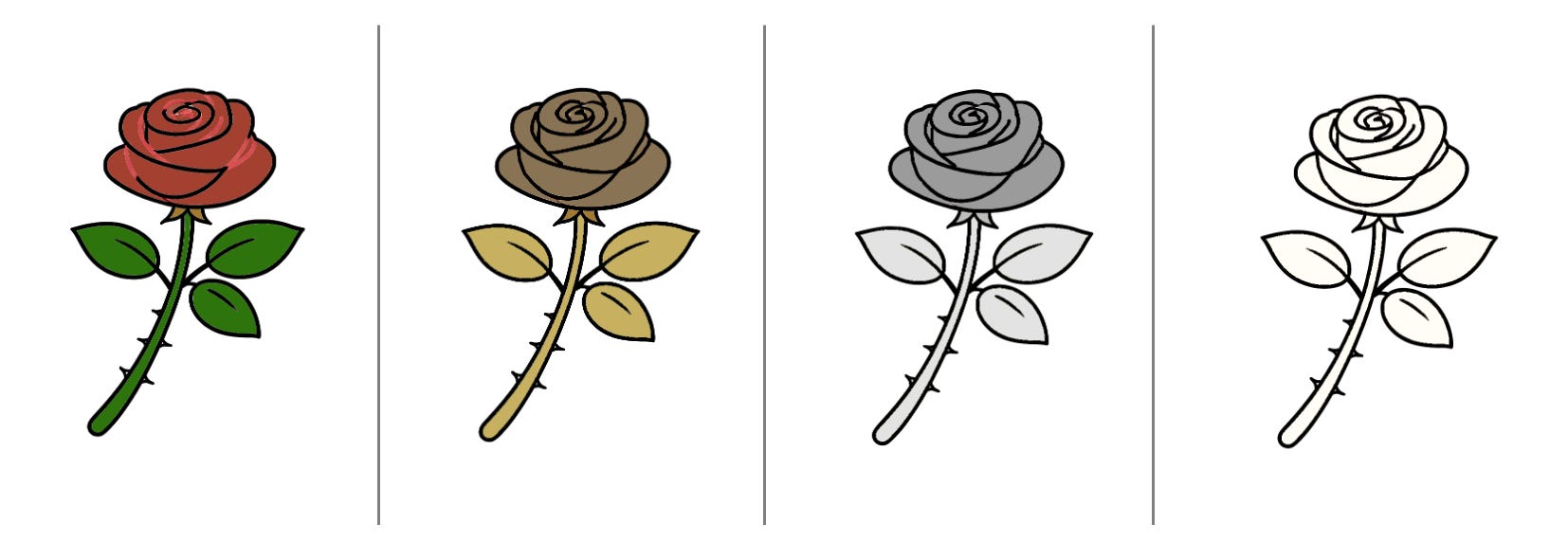
The answer is neither. The difference between Piper and you is not the rose, but how your senses and brain process it. The rose has physical properties that are part of “true” reality, but the color and smell you both experience are perceptions in your mind and not properties of the world. You and Piper can never experience the true version of the rose.
Our Biological Limits
The same thing happens between people. Two people can witness the same event, hear the same words, or read the same sentence, and walk away with vastly different experiences that feel real. Direct access to true, objective reality is out of reach.
Why? Because we’re all limited by our senses. The very idea of a rose is based on how it looks, smells, and feels to us. We have no other way to understand it. Our experience is just the human version, and it’s easy to mistake it for reality itself.
This matters because we don’t just observe reality, we use our senses and our minds to experience a version of it that’s unique to us as humans, and as individuals. Each person experiences reality through filters that reflect a lifetime of learning.
When we assume our experience is reality itself, we assume everyone else shares the same baseline. This assumption makes misunderstanding inevitable. We talk past one another, argue about facts that feel obvious, and struggle to explain things we understand clearly. The problem isn’t intelligence or information, but a mismatch of baselines. We automatically work from the reality we know.
How Do We Solve the Baseline Problem?
The solution to this problem is bigger than one article. But the answer lies first in recognizing that we all work from different baselines. Our entire lives are spent existing in a reality that is unique to us, yet feels real and shared.
The key, going forward, is thinking about how to craft explanations that create a workable starting point, one that we can reasonably assume is shared between us and our audience. We’ll do that by considering how the mind filters and evaluates incoming information.
A Powerful Metaphor
I was recently inspired by the 2022 book An Immense World, Ed Yong. In it, he outlines the incredibly diverse ways that animals perceive reality. Like Piper and the rose, it inspired me to think about what is real.
One quote from the book’s introduction stood out and helped me see an approach to solving the baseline problem. Yong writes:
Earth teems with sights and textures, sounds and vibrations, smells and tastes, electric and magnetic fields. But every animal can only tap into a small fraction of reality’s fullness. Each is enclosed within its own unique sensory bubble, perceiving but a tiny sliver of an immense world.
This is true for humans, too. We all live in a sensory bubble that represents our version of reality, our baseline of what feels real to us. This sensory bubble metaphor has real power in analyzing communication and explanation. In the next post, we see how our bubbles influence our understanding and what it takes for information to move between bubbles.
If You Enjoyed This Post
Please consider hitting the ♡ button below (it helps others find this post)
I’d love to hear from you. Leave a comment, and we can chat.
Know someone who would enjoy this? This post is public, so feel free to share.
Meet the audience where they are, not where you happen to be standing!
Another thoughtful post. I'm working on a book for businesspeople who have to deal with "wicked" problems. These problems are not morality-based, but rather problems with poor formulation and answers that are not right/wrong but shades of good/better. Your comments on baseline are very helpful. Thanks.