


I’ve been writing The Science of Explanation for nearly a year, and I think it’s time to take a step back and look at what we’ve learned. We’ll do this through the experience of a recurring character: Olivia at the doctor’s office.
Readers will remember that her doctor showed her concerning cholesterol numbers and provided multiple recommendations on how to be healthier. But Olivia only remembered and acted upon one: eat more fiber to reduce cholesterol.
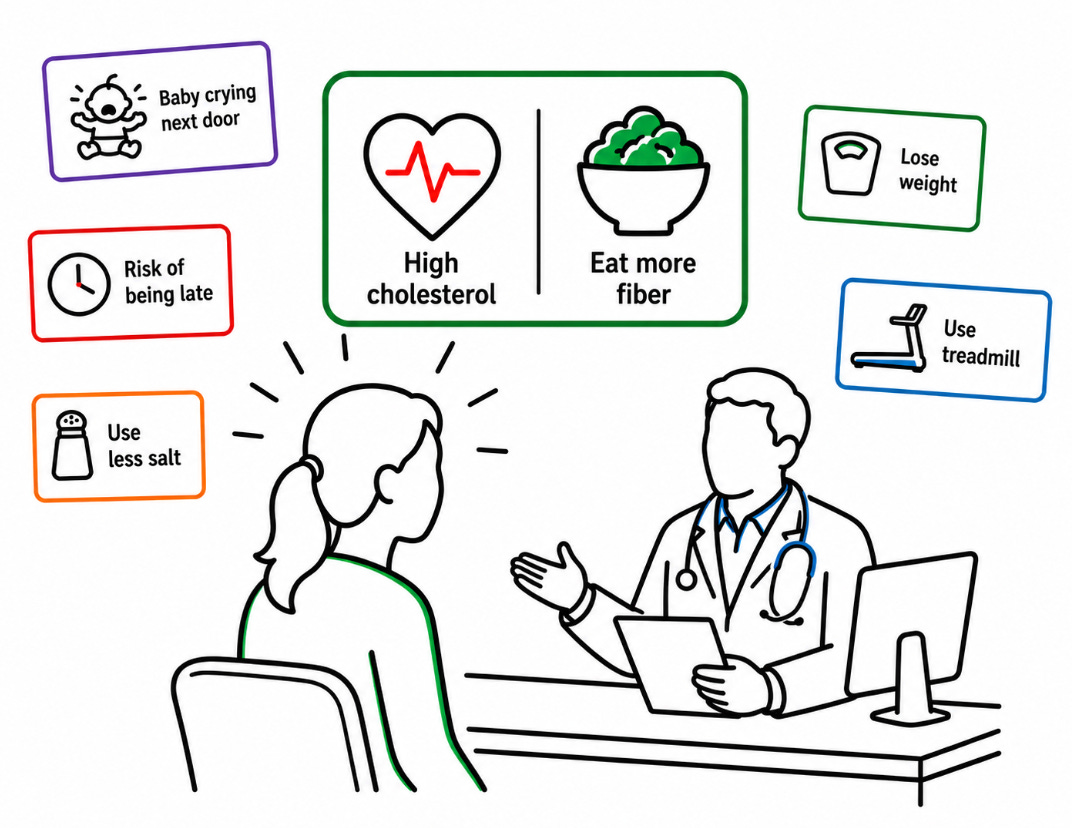
This sets up the driving question: why did that idea survive when everything else was forgotten? What was happening in her mind that helped her remember?
And for the purpose of this newsletter: What can we learn about making an explanation stick?
Here’s where we’ve been so far:
Representation
We can’t read minds. When we explain, we have to represent our knowledge through words, images, and examples that we create. The doctor turned medical knowledge into a verbal explanation Olivia can interpret.
Explanation tip: Knowing the subject is only the starting point. The words, examples, and visuals you use to represent that subject matter. Do it with their existing knowledge in mind.
Read more: What Happens When We Explain
Sensory bubble
By simply being human, we are limited by our senses. This means we live in a sensory bubble that only provides access to a slice of the world around us. Information must be able to enter that bubble in order to be processed.
Olivia could clearly hear the doctor’s voice even with distractions like the crying baby in another room. Her mind picked up that voice and processed it.
Explanation tip: Consider the conditions in which someone encounters your explanation. Reduce distractions and make your message clear and obvious.
Read more: Inside the Sensory Bubble
Attention
When information competes for our attention, we automatically prioritize what matters to us. The cholesterol advice earned Olivia’s attention because cholesterol threatens her goal of staying healthy. The other advice didn’t matter as much to her.
Explanation tip: Give people a reason to care early. Connect your idea to a goal, concern, or question they already have.
Read more: The Limits of Attention at the Doctor’s Office
Gist
We quickly form an overall impression before examining the details. In a split second, Olivia recognizes the familiar situation: a doctor reviewing her health and recommending changes. This prepares her mind for incoming information.
Explanation tip: Make the big picture easy to grasp. A clear title, opening sentence, or simple image can help people see what the explanation is about before you introduce the details.
Read more: Your Mind Gets the Gist in 100 Milliseconds
Context
New information gains meaning through connections to what we already know. Olivia already knows cholesterol is connected to heart disease, and she has a family history of problems. The doctor connected eating fiber to that context: her family history and anxiety about health.
Explanation tip: Context matters. Build it by describing something familiar to your audience, then make the connection to the new idea explicit. Don’t assume they can see how context holds the facts together. Show them.
Read more: How Context Leads to Understanding
Working memory
The human mind has hard limits. We can hold and work with only a small amount of information at once. Olivia tries to keep several recommendations in mind, but cannot give them all equal consideration. But fiber and cholesterol make it through.
Explanation tip: The rule of thumb is that we can keep about four items in working memory. Limit how many unfamiliar ideas people must hold in mind at once. Build in small steps, and keep essential information visible so they can refer back to it.
Read more: The Science of Working Memory: How Do We Know?
Chunking
Your mind groups familiar, related information into units that are easier to manage. Instead of seeing fiber, cholesterol, and heart health as separate ideas, her mind groups them into an overall idea, like heart health, that uses less working memory and frees up mental resources.
Explanation tip: Show how individual details belong together, then give the group a useful name. Remember that a concept that seems like one familiar idea to you may contain several unfamiliar ideas for your audience.
Read more: We Think in Chunks: Video Explainer
Cognitive load
We make mistakes when information is overwhelming. When something is inherently complex, or presented in a confusing manner, we spend mental resources on deciphering it instead of making sense of it.
Plain language reduces the effort Olivia spends deciphering the doctor’s advice, leaving more capacity to consider it.
Explanation tip: Review your communication and look for things that might cause your audience to be confused. Explain unfamiliar terms, simplify cluttered visuals, and leave out details that distract from the main idea.
Read more: What Is Cognitive Load? Why Does It Matter?
System 1 and System 2
Some thinking happens automatically; other thinking requires deliberate effort. Olivia immediately recognizes cholesterol as a concern (System 1). On the drive home, she deliberately considers what to do about it (System 2).
Explanation tip: Use this idea to organize your explanation. Make the idea approachable at first, then give people a reason and an opportunity to think it through. A question about how it applies to their lives can invite that reflection.
Read more: Two Ways of Thinking, Two Explanation Challenges
Understanding
Understanding an idea reaches beyond remembering facts to seeing connections and applying them. It also means being able to explain the mechanisms at work and what to expect if a variable changes.
Olivia’s understanding becomes useful when she can explain why fiber helps and use that knowledge to make food choices.
Explanation tip: Go beyond stating what is true to explain why it works. Ask people to apply the idea to a new example to reveal what they understand and where gaps remain.
Read more: If You Can’t Explain It Simply…
Patterns (or Schemas)
We use patterns built from experience to interpret new information and anticipate what happens next. Olivia didn’t have to guess what to do at the doctor’s office. She’s been there before. Her existing ideas about diet and health help her interpret the advice, but could also lead her to assume she understands more than she does.
Explanation tip: Consider what your audience might expect based on past experience. This may create a bias that needs to be overcome. If your idea works differently, show where the familiar pattern stops applying.
Read more: Why Being Wrong Can Feel So Right
Reasoning
Reasoning is how we decide what to believe and what to do next. When someone makes a claim, we examine the grounds for it and consider the implications. Olivia trusts her doctor, and their explanation connects with what she already knows about cholesterol and heart disease. Together, these give Olivia reasons to accept the advice and change her lifestyle. She sees the logic clearly.
Explanation tip: Make your reasons visible. Show what supports your claim and how it leads to your conclusion, so people can evaluate it for themselves. Organize your communication to be logical.
Read more: Reasoning Backward and Forward
What’s Next?
My plan is to wrap up this series at the end of the year before moving on. The next posts will focus on memory, encoding, and recall.
We’ll answer questions like: What helped the fiber advice become part of her long-term memory? What brought it back to mind when she was making a grocery list?
With those posts in place, we’ll have a foundation to build upon for next year. Stay tuned!
If You Enjoyed This Post
Please consider hitting the ♥️ button below (it helps others find this post)
I’d love to hear from you. Leave a comment, and we can chat.
Know someone who would enjoy this? This post is public, so feel free to share.